Why the pace of reform, not the reforms themselves, is becoming the defining challenge for schools and trusts.
This morning, between responding to safeguarding alerts, reviewing system changes, and chasing operational issues across multiple schools, I read that the Children’s Wellbeing and Schools Bill has received Royal Assent.
None of those tasks felt unusual. None of them felt especially strategic.
But together, they tell a story about the current state of our system.
Because while policy moves forward at pace, with changes spanning uniform policy, admissions, curriculum, inspection, and workforce, the operational reality remains constant: leaders are trying to hold everything together at once.
And that leads to a simple but uncomfortable question:
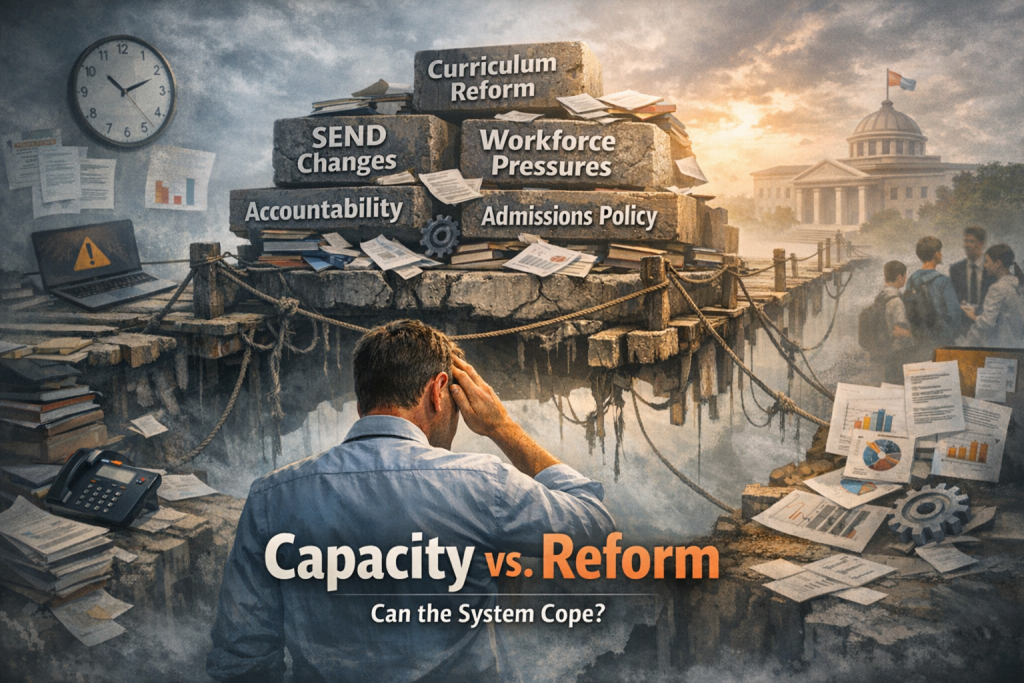
What happens when reform outpaces the system’s capacity to deliver it?
Reform is Not the Issue
Across the sector, there is no shortage of willingness to improve.
Leaders within trusts and schools are used to navigating change. Over recent years alone, the system has responded to:
- Pandemic disruption
- Rapid digital transformation
- Evolving safeguarding expectations
- Significant shifts in accountability frameworks
The challenge we now face is not resistance to reform, it is accumulation.
The current reform programme spans multiple domains simultaneously:
- Curriculum and assessment
- SEND reform
- Trust accountability and inspection
- Workforce conditions
- Admissions frameworks
Each change, in isolation, is manageable. The complexity arises when they land at once, on the same finite set of people, systems, and processes.
The Constraint is Capacity
In practice, schools and trusts do not implement policy in neat, discrete workstreams.
Policy becomes:
- meetings in already full diaries
- process changes layered on top of existing processes
- system updates that must integrate with legacy infrastructure
- communications that require translation for different audiences
Capacity, time, expertise, cognitive load; becomes the defining constraint.
A leadership team may understand what needs to change. The challenge is finding the space to:
- interpret it
- plan it
- resource it
- deliver it
- monitor it
…whilst maintaining the day-to-day operation of a complex organisation serving children and families.
The Risk is Fragmentation, Not Non-Compliance
When systems are under strain, the greatest risk is not that organisations refuse to comply.
It is that delivery becomes fragmented.
This can look like:
- different parts of a trust prioritising different reforms
- uneven implementation between schools
- critical dependencies (data, systems, people) not aligning at the right time
- well-intentioned changes creating unintended operational friction
In these circumstances, compliance may still be technically achieved but the coherence that underpins effective implementation begins to erode.
The Hidden Layer: Operational Reality
Much of the policy conversation focuses on intent and outcome.
Far less visible is the operational layer where these reforms are actually enacted.
This is where leaders are:
- aligning systems that were never designed to work together
- balancing resource across competing priorities
- dealing with supplier constraints and market volatility
- interpreting guidance that is still evolving
It is also where trade-offs are made.
Time spent implementing one reform is time not spent on another initiative. Investment in one system reduces flexibility elsewhere.
These decisions are rarely visible in policy discussions but they shape outcomes in very real ways.
Why System-Level Thinking Matters
The sector has become increasingly sophisticated in how it thinks about:
- school improvement
- professional development
- evidence-informed practice
However, we are still developing our collective understanding of system capacity.
A reform, however well-designed, does not exist in isolation. Its effectiveness depends on:
- what else is happening at the same time
- how it interacts with existing systems
- whether there is enough capacity to implement it coherently
Without this perspective, there is a risk that:
- strong policies deliver weaker results than intended
- reform fatigue sets in at organisational level
- variability across the system increases
A Shift in Perspective
If we accept that capacity is now the limiting factor, then the conversation needs to evolve.
This is not about slowing down improvement. It is about strengthening the conditions that allow improvement to happen.
This might include:
- greater visibility of the cumulative reform load on trusts
- clearer sequencing and prioritisation across policy areas
- recognition of implementation time, not just policy development time
- a more explicit focus on the operational realities of delivery
These are not easy shifts. But they are necessary if reform is to translate into sustained impact.
Final Reflection
This week didn’t feel like “system reform” work.
It felt like firefighting, coordination, translation, and problem-solving, repeated across dozens of small interactions.
And yet, that is the system absorbing reform.
Across the sector, leaders continue to adapt, respond, and deliver, often at remarkable pace.
The question is not whether the system is capable of change. It clearly is.
The question is how much simultaneous change it can absorb while maintaining coherence, quality, and focus on the children it serves.
Because ultimately:
It is not the scale of reform that determines success—
but the capacity of the system to carry it.