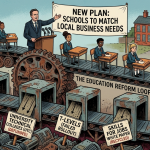
Across the education system, expectations are rising—but certainty is not.
Schools are being asked to deliver improved outcomes, close disadvantage gaps, strengthen safeguarding, embed inclusion, and respond to evolving accountability frameworks. At the same time, the structural context in which these expectations sit remains fluid. Policies are still being consulted on, funding remains constrained, and workforce pressures continue to build. The result is not simply pressure—it is strategic ambiguity.
This matters, because schools do not just operate within policy—they interpret it, implement it, and ultimately carry its consequences.
The weight of reform
The current reform agenda is ambitious. The government’s 2026 schools white paper sets out a long-term direction of travel: a more coherent, trust-led system, strengthened accountability, and a renewed focus on inclusion and pupil outcomes (House of Commons Library, 2026). 1
There is much within this that school leaders will recognise as necessary. Greater collaboration between schools, clearer expectations for inclusion, and a more consistent system architecture all respond to genuine structural challenges.
However, these reforms do not sit in isolation. They are being introduced alongside ongoing changes to funding frameworks, operational guidance, and system processes, reflected in regular Department for Education updates to the sector (Department for Education, 2026a). 2
Individually, each change may be manageable. Collectively, they create a landscape in which the strategic direction is broad, but the path itself is still being defined.
The capacity gap
At the same time, the capacity of the system to absorb this level of change is becoming increasingly stretched.
Financial pressures remain acute. Recent analysis shows a growing number of academy trusts operating with significant deficits, even as others have improved their position. The overall picture reflects a system under sustained strain, where financial sustainability is becoming more difficult to maintain (Schools Week, 2026). 3
Workforce pressures compound this challenge. Reports of potential industrial action highlight ongoing concerns about pay, workload, and retention, with unions signalling that strike action is likely if pay awards do not keep pace with inflationary pressures (Mirror, 2026). 4
These pressures are not abstract. They translate into real decisions in schools and trusts—about staffing structures, curriculum delivery, and the prioritisation of limited resources. What emerges is a system being asked to deliver more, while operating with less flexibility to absorb risk.
The operational reality
For school leaders, this tension is experienced not through policy announcements, but as day-to-day operational reality.
Leaders are required to respond to evolving safeguarding expectations, prepare for changes to accountability systems, manage complex financial planning cycles, and ensure consistent outcomes for pupils. All of this must be delivered while elements of the system remain in flux.
For example, aspects of assessment policy continue to evolve, with measures such as the provision of formula and equation sheets in GCSE exams continuing beyond their original introduction, supported by strong sector backing (Schools Week, 2026). 5
This creates a subtle but important challenge. When key features of the system are still evolving, leaders are required to make long-term decisions based on short-term clarity. This is not a failure of leadership—it is a structural condition of the current environment.
The risk of ambiguity
Where reform outpaces clarity, uncertainty becomes an operational risk.
This is not uncertainty in the sense of inaction. School leaders remain highly skilled at navigating complexity. Rather, it is uncertainty in the sense of making strategic decisions without a stable endpoint.
In this context, several risks begin to emerge:
- Short-term decision-making, where immediate pressures take precedence over long-term strategy
- Reform fatigue, where cumulative change reduces capacity for innovation
- Inconsistent implementation, as variation increases across the system
- Reduced strategic confidence, where leaders are less certain that current decisions will align with future expectations
These risks are not inevitable, but they become more likely when the pace of reform exceeds the system’s ability to embed it effectively.
Sequencing matters
It is important to be clear: the issue is not reform itself.
Few would argue against the need to improve outcomes, strengthen inclusion, or create a more coherent education system. The strategic direction is, in many respects, widely supported.
The challenge lies not in the ambition, but in the sequencing.
When multiple reforms are introduced simultaneously—across structure, accountability, and operational processes—the system is required to respond on several fronts at once. This makes prioritisation more difficult and reduces the opportunity to stabilise and evaluate change.
In other sectors, large-scale transformation is often deliberately sequenced to ensure that capacity is built before expectations are raised. In education, the urgency of need can compress these timelines, increasing the risk of system strain.
What we might be considering
If the system is to deliver on its ambitions, there may be value in reflecting on how reform is experienced at the point of implementation.
This could include:
- Prioritisation over proliferation
Ensuring that the most critical reforms are clearly identified, enabling leaders to focus effort where it will have the greatest impact - Clarity before accountability
Providing greater stability in how success is defined before expanding mechanisms for measuring it - Investment in capacity
Recognising that workforce, funding, and leadership time are finite, and aligning expectations accordingly - Deliberate sequencing
Phasing reform in a way that allows the system to embed, evaluate, and adjust before introducing further change
These considerations do not diminish the importance of reform. Rather, they recognise that sustainable improvement depends not only on what changes, but on how change is managed.
A system in transition
It is possible that what we are seeing is not dysfunction, but transition.
Education systems evolve gradually. The move towards a more collaborative, trust-led model, combined with a renewed focus on inclusion and outcomes, represents a significant shift. In that context, some degree of uncertainty may be inevitable.
However, the experience of that uncertainty matters.
For those working within the system, the question is not whether change is necessary, but whether it is navigable in practice.
Conclusion: direction without distortion
Schools have always done more than the system formally asks of them. They adapt, they innovate, and they respond to the needs of their communities.
What is different now is not the level of expectation, but the level of certainty that surrounds it.
As reform continues, there may be value in ensuring that clarity of direction is matched by stability of delivery. Without that balance, there is a risk that ambition becomes distorted by the conditions in which it is implemented.
The challenge, then, is not simply to continue reform—but to ensure that it is sequenced, supported, and sustained in a way that enables schools to deliver it effectively.
Because ultimately, the success of any education system is not determined by the policies it sets, but by the extent to which those policies can be realised in practice.
—
References
Department for Education (2026a) DfE Update: 6 May 2026. Available at: GOV.UK. 2
House of Commons Library (2026) 2026 schools white paper: Plans for wider school reform. 1
Mirror (2026) Teachers will ‘almost certainly strike’ over pay as inflation rises. 4
Schools Week (2026) More academy trusts £1m+ in the red, but others improve. 3
Schools Week (2026) GCSE exam formula and equation sheets to continue. 5