When I read the news this week that the Prime Minister and Andy Burnham are planning to tell schools in England to adapt their teaching to local business needs, I had a profound sense of déjà vu. The latest headline claims the government wants curriculums for students aged 14 and above to be “more responsive to the local jobs market.”
It sounds great on paper, doesn’t it? But as I read it, I was quite sure I had heard almost exactly the same rhetoric from countless Prime Ministers and Education Secretaries over the last 20 years”usually with very little to show for it in the end.
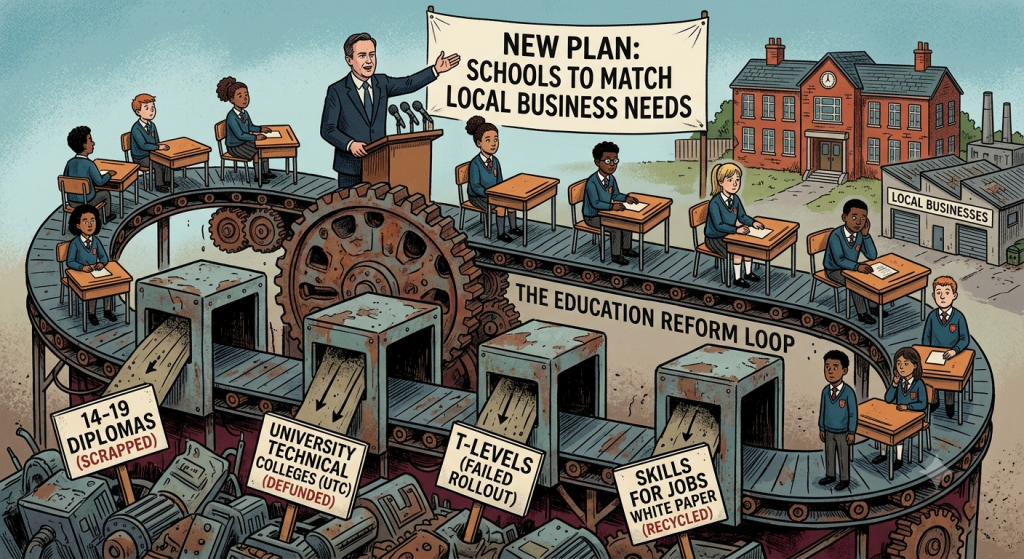
Curious if my memory was playing tricks on me, I decided to do some digging into the archives. Unsurprisingly, it turns out that “aligning the curriculum with local business needs” is one of the most frequently recycled, heavily hyped, and subsequently abandoned policies in modern UK political history. Regardless of the party in power, it seems every government announces a “revolutionary” scheme to match 14-to-19 education with local industry, only for it to be quietly scrapped, underfunded, or replaced by the next administration.
Here is a look back at the last two decades of identical promises.
2008: The New Labour “14-19 Diplomas”
During the Gordon Brown years, there was a massive push to combine academic learning with vocational skills tailored to employers. In 2008, Education Secretary Ed Balls excitedly announced the rollout of new “14-to-19 Diplomas.” Addressing Parliament, he boasted that this distinctive new curriculum successfully combined theoretical studies with practical work, propped up by a network of “diploma employer champions” (Balls, 2008).
The Result: The diplomas were heavily criticised for being overly complex and failed to gain widespread university or employer recognition. They were swiftly scrapped by the Conservative-Lib Dem coalition government shortly after they took power in 2010.
2010–2016: The Coalition’s University Technical Colleges (UTCs)
Determined to make their own mark, David Cameron and George Osborne championed the creation of University Technical Colleges (UTCs) for 14-to-19-year-olds. The defining pitch was that these colleges were explicitly co-designed by local universities and local employers to fix the skills mismatch between what employers expect school-leavers to have and what schools actually teach (PoliticsHome, 2022).
The Result: While a handful of UTCs found their footing, the broader project struggled immensely. Many suffered from severe under-enrolment and financial difficulties. Why? Because mainstream secondary schools were largely reluctant to let go of their pupils at age 14, and parents were hesitant to move their children into untested institutions. Several UTCs ended up closing down entirely or converting to standard academies.
2017: Theresa May and the T-Level Revolution
Fast forward a few years, and Theresa May’s government decided it was their turn to bridge the gap. They introduced “T-Levels” (Technical Levels) as the vocational equivalent to A-Levels, intended as a flagship policy to integrate schooling directly with local industry. In 2017, Education Secretary Justine Greening declared: “We are transforming technical education in this country… so that our young people have the world class skills and knowledge that employers need” (Department for Education, 2017).
The Result: T-Levels faced severe rollout issues. A core requirement of the qualification was a mandatory 45-day local industry placement. However, the government quickly discovered a massive hurdle: finding enough local businesses with the time, money, or staff capacity to take on students was incredibly difficult, especially in areas with weaker local economies.
2021: Boris Johnson’s “Skills for Jobs” White Paper
Not to be outdone, in 2021 the government yet again claimed it was rewriting the rulebook on education and local jobs. Education Secretary Gavin Williamson launched the Skills for Jobs White Paper, declaring that the government was “realigning the whole system around the needs of employers.” He promised that business groups, including local Chambers of Commerce, would work alongside educators to develop tailored skills plans to meet local training needs (Department for Education, 2021).
The Result: The rhetoric here is nearly verbatim to what has just been announced today in 2026. Ultimately, the constant turnover of Education Secretaries in the final years of that Conservative government completely derailed the long-term momentum required to actually implement these localised employer-skills networks.
Why Doesn’t It Ever Stick?
Having looked at the history, it’s clear that a recurring cycle thwarts these ambitions time and time again.
Firstly, there is the issue of employer capacity. Politicians love to mandate that schools must work with local employers, but local businesses are out there trying to survive and make a profit. They often simply don’t have the resources to provide hundreds of meaningful work placements or sit on endless curriculum design consultation boards.
Secondly, the “Age 14” dilemma. Trying to divert 14-year-olds into specialised or job-focused streams is incredibly difficult. Most parents, schools, and even universities still heavily favour standard, traditional academic pathways (GCSEs and A-Levels), making it hard for these new initiatives to gain prestige.
Finally, policy churn. By the time a new vocational or localised education system is embedded into schools, a new government or new Education Secretary steps in, scraps it, and slaps their own branding on a “groundbreaking” new initiative.
So, as we listen to the latest announcements about adapting 14-to-19 curriculums to the local jobs market, forgive me for rolling my eyes. It is an objective championed by New Labour, the Coalition, and successive Conservative governments over the past twenty years. Until we fix the underlying structural issues, this latest promise will likely end up in the exact same graveyard as the rest of them.
References
- Balls, E. (2008) Education: 14-19 Reform. Hansard, House of Commons debates, 13 October, col. 30. Available at: https://hansard.parliament.uk/Lords/2008-10-13/debates/0810133000003/Education14-19Reform (Accessed: 28 July 2026).
- Department for Education (2017) Justine Greening: Speech at DfE Skills Summit. Available at: https://www.gov.uk/government/speeches/justine-greening-speech-at-dfe-skills-summit (Accessed: 28 July 2026).
- Department for Education (2021) Pioneering reforms to boost skills and jobs. Available at: https://www.gov.uk/government/news/pioneering-reforms-to-boost-skills-and-jobs (Accessed: 28 July 2026).
- PoliticsHome (2022) ‘With an ethos of learning by doing, UTCs bridge the gap between the world of education and the world of work’, PoliticsHome, 24 January. Available at: https://www.politicshome.com/thehouse/article/with-an-ethos-of-learning-by-doing-utcs-bridge-the-gap-between-the-world-of-education-and-the-world-of-work (Accessed: 28 July 2026).