Putting safety and dignity before novelty
In education, the most important changes are not always the most visible, nor the most complex. Often, they are the ones that remove barriers quietly, without drawing attention to themselves.
Over the past few years, I have been closely involved in digital change across schools. Systems, infrastructure, access, transformation. All of it matters. But the most powerful lesson I have learned about technology in education did not come from strategy or scale.
It came from something much smaller.
One of the most impactful changes I have been involved in was the introduction of a cashless catering system.
Before it was introduced, pupils entitled to free school meals followed a different routine to their peers. While others queued for lunch with friends, these pupils first queued separately to collect an orange slip of paper. Only then could they join the main queue, handing over the slip instead of paying cash.
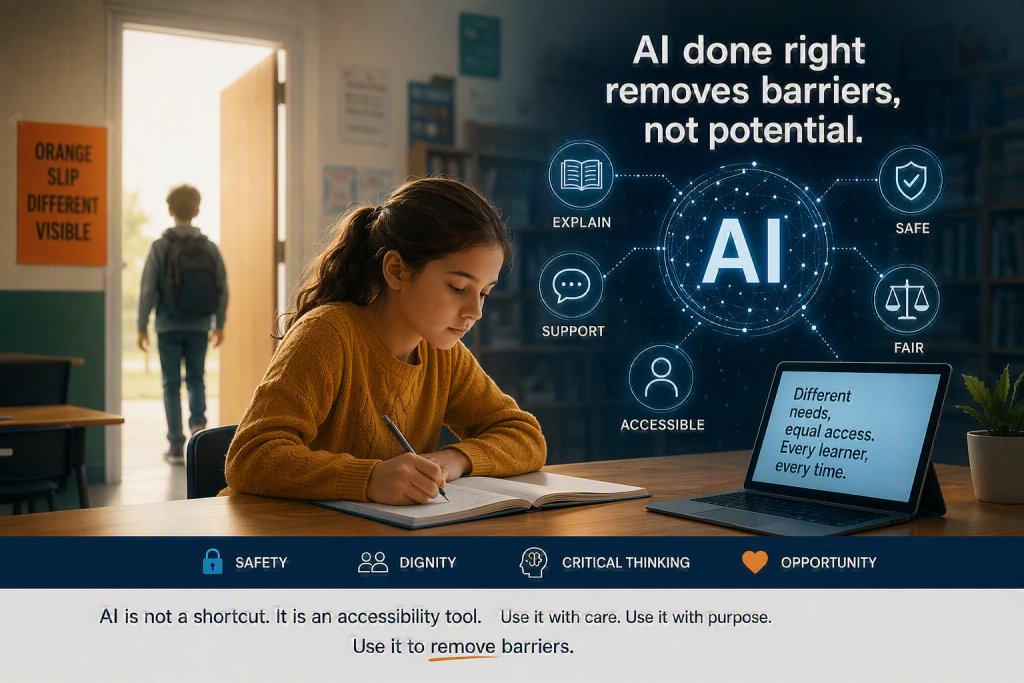
Everyone knew what the orange slip meant. It marked pupils out as different. It made disadvantage visible.
Unsurprisingly, take up of free school meals was low. Why opt into something that publicly identifies you?
When cashless catering was introduced, that changed overnight. Allowances were applied automatically. Pupils queued together and paid in the same way as everyone else. The distinction disappeared, and take up rose significantly.
The support had not changed.
The dignity had.
Why this matters now
As schools begin to engage more seriously with artificial intelligence, it is easy to focus on novelty, on what the technology can do, on how quickly it is evolving.
The more important question is what it removes.
For me, this is personal.
I am dyslexic. My thinking is fast, but not always neat. I have spent years navigating spelling, sequencing, and the challenge of turning ideas into polished writing. The difficulty was never in the thinking. It was in the translation.
Today, I use AI to help shape rough, sometimes poorly structured outlines into something I can share. It does not give me better ideas. It removes a barrier between what I think and what I can communicate.
My disability has not disappeared.
But, like the orange slip, the visible marker of difference has.
AI as an accessibility tool
Used carefully, AI has the potential to have a similar impact in the classroom.
It can explain concepts in multiple ways, it can slow language down without lowering expectations, it can allow pupils to ask questions privately that they might never ask aloud, it can provide scaffolding that would otherwise require significant additional support.
This is not about replacing teaching.
It is not about AI having the answers.
It is about responsiveness, meeting learners and staff where they are, at the moment they need support, without broadcasting difference.
In that sense, AI is not a shortcut.
It is an accessibility tool.
And like all accessibility tools, its value lies not in what it adds, but in what it removes.
Guardrails create confidence
None of this works without trust.
AI is not sentient. It does not understand context, children, or consequence. It cannot be held accountable, and it should never replace professional judgement. It is a large language model, not a source of truth.
That matters in education, where the stakes are high. We are working with children, with safeguarding responsibilities, with protected characteristics, and with real consequences if things go wrong.
The question is not whether AI should be used.
It is how it is used, where it is used, and under what conditions.
This means moving away from open, unstructured access and towards environments where use is visible, bounded, and deliberate.
When AI is implemented in this way, three things become possible.
Data can be protected.
Safeguarding expectations can be maintained.
Experiences can be consistent.
But just as importantly, AI becomes something that is understood, not just consumed.
From using AI to understanding AI
One of the risks with AI is the illusion that it provides a single, correct answer. In reality, outputs vary. Different prompts, different models, different contexts lead to different responses.
When this variation is made visible, something much more educational happens.
Staff and pupils begin to compare outputs.
They notice differences in tone, accuracy, and bias.
They ask questions about why those differences exist.
They begin to understand how responses are generated.
This is a subtle shift, but an important one.
AI moves from being something to use, to something to understand.
It removes the illusion of certainty and replaces it with evaluation, judgement, and informed comparison.
Teaching critical thinking, not dependency
Even in well controlled use, AI will get things wrong. It will be incomplete, sometimes inaccurate, sometimes inappropriate.
That is not a failure. It is a reality.
If AI is to act as a leveller rather than a risk, both pupils and staff must be taught how to engage with it critically.
This cannot be assumed.
Familiarity with technology does not mean understanding. In fact, the confidence with which AI presents information makes critical thinking more important.
Pupils need to learn that outputs can be wrong, even when they sound convincing. Confidence does not equal accuracy. First answers are rarely the best answers. Comparison improves judgement. Questioning matters more than accepting.
These ideas are not new. They reflect what education has always valued, curiosity, reasoning, and scepticism.
What AI changes is the speed and accessibility of responses, which increases the need for these skills to be taught deliberately.
In practice, this means shifting the questions we ask.
Not, what answer did the AI give.
But, how reliable is that answer.
What is missing.
How could it be improved.
Which version is stronger, and why.
This reframing moves AI from being an authority to being a starting point for thinking.
Over time, this builds habits that extend beyond AI itself. Pupils begin to question sources, challenge ideas, and seek evidence.
Equity and unintended consequences
There is also an important equity dimension.
Without explicit teaching, the greatest benefits of AI will go to those who already have the confidence and language to question it. Those who accept responses at face value risk becoming more dependent, not more empowered.
This makes critical thinking central, not optional.
For staff, the same principle applies. AI can support, suggest, and scaffold, but it cannot replace the professional judgement of a teacher who understands context, learners, and nuance.
Used properly, AI supports expertise.
It does not replace it.
Dignity before novelty
There is no shortage of risks associated with AI, data protection, bias, workload, misuse. These concerns are real and deserve attention.
But if we focus only on risk, we miss the quieter opportunity.
The lesson from the orange slip was not about technology.
It was about dignity.
The system did not change the entitlement. It removed the visibility of disadvantage.
AI has the potential to do something similar.
When access to explanation, iteration, and support becomes normal, rather than something provided separately, participation increases.
The difference matters less when support is built into the system itself.
A careful path forward
This is not a sprint. It is careful, deliberate work.
But with the right guardrails, a clear focus on safety and dignity, and an emphasis on understanding rather than blind adoption, AI can become something more meaningful.
Not a novelty.
Not a shortcut.
But a tool that helps remove barriers.
A prompt for questioning.
A way to refine thinking.
A means of exploring alternatives.
A partner in learning.
In short, it can help open doors that have been closed to too many learners.
Quietly, safely, and with confidence.